








Infertility and assisted reproductive technology (IVF)
Content
Description
Infertility is a condition where a man and woman are unable to achieve conception of a child within one year through unprotected sexual intercourse.
About 10% of couples are infertile. The risk factors are on the side of the woman (30%), the man (30%), sometimes both couples (30%) and sometimes the cause is not clear (10%). Therefore, the couple comes to the consultation together.
Assisted reproduction (assisted reproductive technology - ART, or IVF - in vitro fertilization) offers the possibility of conceiving and carrying your own child.
Facts
- General anesthesia
- One-day hospitalization
- Need for more sessions
- Pregnancy is verified after 14 days
The causes of infertility include general causes that are present in both sexes such as older age, smoking, stress and poor health style, oncological and genetic diseases (e.g. testicular and ovarian cancer) and chronic diseases (diabetes, kidney and liver disease), untreated venereal diseases (sexually transmitted diseases - STDs). In some cases (10-15%), the cause of infertility is not revealed.
Causes of female infertility:
- When determining the causes of infertility in a woman, it is necessary to focus on the overall state of health of the woman and especially on the sexual organs (ovaries, fallopian tubes, uterus, vagina).
- The first problem may be altered anatomical conditions - for example: obstruction of the fallopian tubes after adhesions (congenital or as a result of inflammation), or a low number of suitable eggs, fibroids, polyps, cervical stenosis, congenital anomalies of the uterus an others.
- Hormonal changes - the menstrual cycle is controlled by hormones and with altered levels a failure of egg maturation occurs. Hormone changes can also occur due to stress and inappropriate lifestyle (manifested by irregular menstruation, anovulation - (missing ovulation/release of a mature egg), ovarian cysts and polycystic ovary syndrome- PCOS).
- Premature ovarian failure (POI - primary ovarian insufficiency), which is characterized by the loss of ovarian function before the age of 40. The cause is mostly unknown.
- Endometriosis - the inner lining of the uterus is called the endometrium. It is in the endometrium where the fertilized egg is embedded. The disease endometriosis means that this lining is also located in a place other than inside the uterus (for example in the muscular layer of the uterus, in the ovaries or on other organs).
- Immunity disorders (autoimmune syndrome) with the formation of antibodies against the sperm or the egg itself.
- Cervical factor - changes in the cervical mucus, which is impermeable to sperm.
Causes of male infertility:
- Insufficient sperm quality - sperm count and motility.
- Anatomical conditions - obstruction of the vas deferens, problems with erection and ejaculation.
- Use of anabolic steroids and some drugs.
- Autoimmune disorders with the formation of antibodies against sperm
- Infections and inflammations
The examination of the man focuses on the male genitalia and on the ejaculate, which is obtained after 3 days of sexual abstinence. The examination includes:
- Sperm analysis (seminogram or spermiogram) - a repeat examination of the sperm, looking at the volume of ejaculate (typically between 1.5 to 5 milliliters), concentration (typically more than 15 million sperm/ml), motility, morphology and vitality of the sperm.
- Urological examination with ultrasound of the testicles and male genitalia.
- Endocriological and immunological examination to determine the levels of male hormones.
- Special examination of sperm (Genetic damage of sperm - test of DNA integrity and fragmentation of sperm, Oxidative damage of sperm, examination of Anti-sperm antibodies, Sperm function test - ability to of sperm to penetrate and fertilize an egg).
Examination of a woman includes:
- Basic gynecological examination, which is also performed during a preventive examination.
- Ultrasound examination of the ovaries and uterus (shape of the uterus and lining of the uterus).
- Examination of the patency of the fallopian tubes (ultrasound or with a laparoscope).
- Blood sampling for hormonal profile (hormones FSH, LH, PRL and others), AMH – Anti-Müllerian hormone (hormone that informs about the number of eggs in the ovaries - Ovarian reserve test).
- Microbiological and cytological examination of the vagina and cervix.
Currently, several methods are used in the treatment of infertility:
- Folliculometry - a series of ultrasonographic examinations used to determine the period of greatest fertility, this method is suitable for natural fertilization.
- IUI - intrauterine insemination.
- IVF - (in vitro fertilization) - a baby "from a test tube".
In this method, fertilization is achieved by inserting sperm into the uterine cavity using a special catheter. Sperm reach the woman's mature egg by giving the woman an injection that releases the mature egg (triggering ovulation - ovulation induction).
Preparations (pills or injections) are administered to support ovarian activity from days 2 - 5. From the 10th day, the eggs are monitored by ultrasound and the injection inducts the release of a mature egg.
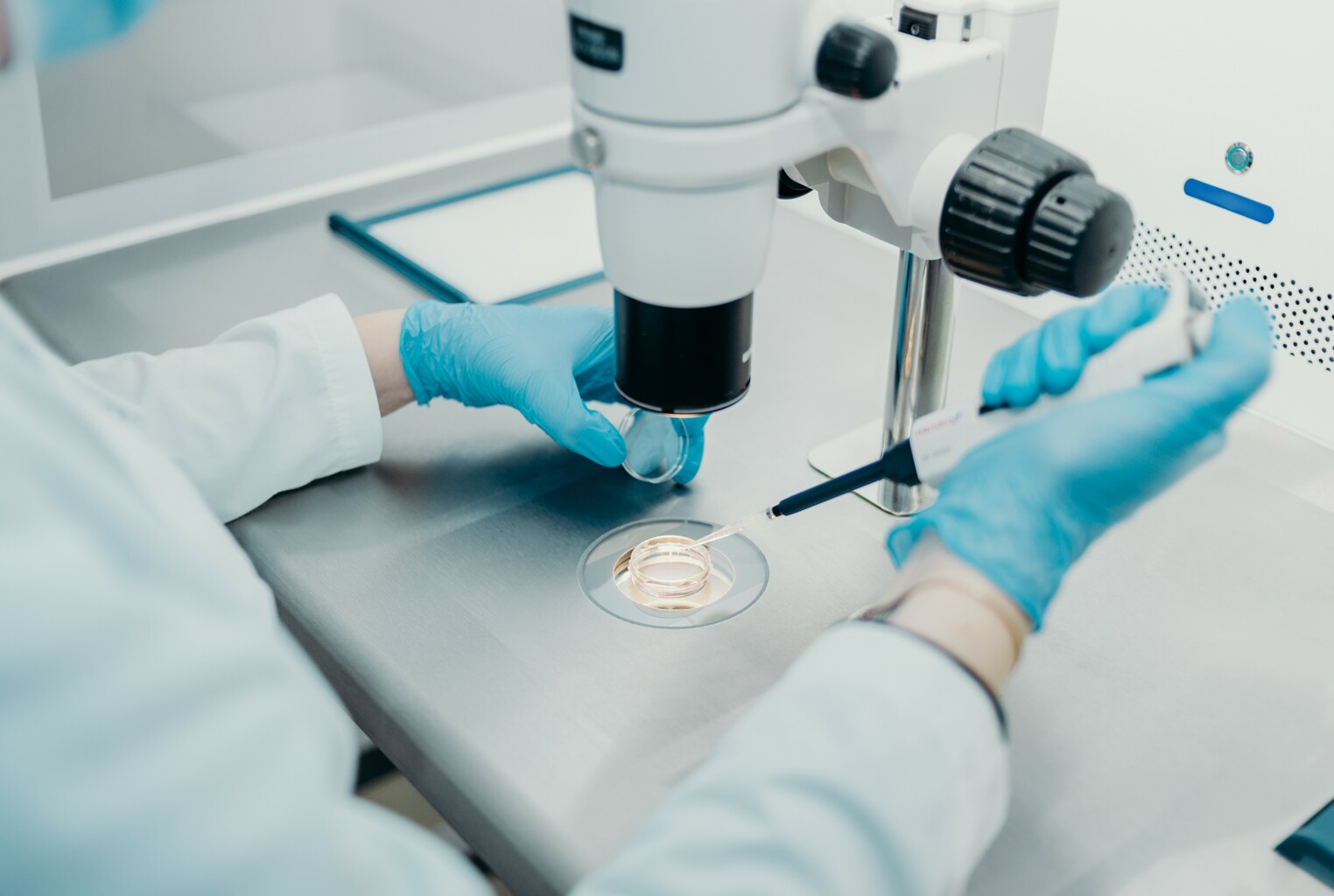
Fertilization of an egg using sperm in the laboratory is referred to as In-vitro fertilization (IVF). Sometimes calles as a method for "a test-tube baby".
The first step is the collection of the egg and its preparation and fertilization, the second step is the transfer (ET - Embryo transfer) of the fertilized eggs into the woman's uterus.
- Egg retrieval
Artificial insemination is carried out by collecting a larger number of eggs from the woman (hormonal injections are given from the 2nd day for 10 - 12 days). The retrieval is done under short-term general anesthesia with a puncture needle inserted through the vagina under ultrasound control.
After the procedure, the patient is monitored for 2 hours and goes home for treatment.
- Transfer
The eggs are then prepared and fertilised using male sperm - this produces fertilized eggs (zygotes) which develop into embryos.
In the case of poor quality sperm, there is the option of micromanipulation technology - ICSI (intracytoplasmic sperm injection) - direct injection of sperm into the cytoplasm of the egg - so the sperm does not have to cross the egg envelope.
Transfer of the fertilized egg into the uterus takes place on 2nd - 5th day (after embryos beeing cultured). This procedure is painless and is done without the need for anesthesia.
In IVF other techniques are also used to facilitate conception. Therefore, in the course of artificial insemination, the couple may encounter the following concepts:
- IVM – in vitro maturation. In this method, immature female eggs - oocytes are taken and left to mature in laboratories (48 hours), then they are fertilized and can be used for IVF. This method is suitable for patients with hyperstimulation syndrome.
- PGD – Pre-implantation genetic diagnosis is an examination that genetically examines the embryo for the presence of a genetic disorder before implantation into the uterus.
- Surgical sperm extraction in cases where the movement of sperm from the testicles towards the genital organ is disturbed: MESA (micro epididymal sperm aspiration) - suction of sperm from the epididymis, TESE (testicular sperm extraction) - tissue removal from the testicle.
- PISCI - In the case of low-quality sperm, the sperm are injected directly into the cytoplasm of the female egg (intracytoplasmic sperm injection - ISCI), but pre-selected sperm are selected (hence PISCI), which are matured and bound to the hyaluronic gel.
- Donation (egg and sperm or embryo donation) - in some cases, eggs or sperm are not suitable for fertilization. In these cases, frozen sperm or eggs from anonymous donors can be used.
- Native and stimulated cycle - maturation of female eggs repeats in regular 28-day cycles (native cycle). In the event that the patient has an irregular cycle or disorders in the cycles, it is necessary to induce ovulation using hormonal treatment - stimulation (stimulated cycle).
- Social freezing - a term used for the collection and freezing of one's own sex cells (sperm and eggs) so that they are available for future planned parenthood.
After artificial insemination, it is necessary to wait 2 weeks to confirm the pregnancy.
The percentage of successful fertilization is around 50 - 60% per IVF cycle. It is tend to repeat up to 3 cycles, with the percentage of success increasing cumulatively. However, each pair is individual and therefore the results also depend on the specific couple.
The risks of artificial insemination arise from the need to administer hormonal preparations, examinations and interventions under general anesthesia. Risks include:
- Ovarian hyperstimulation syndrome (OHSS) - these are the symptoms of excessive activation of the ovaries: painful enlargement of the ovaries, nausea, dehydration, increased risk of thromboembolic disease and others.
- Multiple pregnancy - the probability is higher than with a normal conception.
- Complications during egg collection and transfer - risk of infection, bleeding, tissue injury in the pelvis.
- There has been no evidence of an increased risk of cancer in women or genetic damage to children born using artificial insemination compared to the general population.
Related procedures
 Gynecology
- Pelvic exam and Preventive gynecological examination
- Hymenoplasty
- Cone biopsy (Conization of the cervix )
- Cervical polyp removal
- Dilation and Curettage (D&C)
- Hysteroscopy
- Hysterectomy
- Childbirth (Delivery)
- C-section (Cesarean birth)
- Contraception and family planning
- Pregnancy consultation and prenatal diagnostics (Prenatal care)
- Female sterilization (Tubal ligation)